

Support at Home Classification 2
Introduction
A little bit of extra help can make a big difference when everyday tasks start becoming harder to manage alone. That’s where Support at Home Classification 2 comes in.
Classification 2 is one of the eight ongoing funding levels available through the Support at Home program. Where Classification 1 may suit people who only need occasional help, Classification 2 is intended for those who need support more consistently.
In this guide, we explain what Support at Home Classification 2 covers, how much funding you can receive and the types of care services you may be able to include in your support plan.
What is Support at Home Classification 2?
Support at Home Classification 2 is generally suited to older Australians who are still largely independent but need more regular help with personal care, household tasks or getting out and about.
While someone receiving Classification 1 may only need occasional help with everyday tasks, Classification 2 is designed for more regular assistance. For example, you might manage many parts of your routine independently but need help showering or getting dressed on certain days.
With a Classification 2 budget, your support plan may include services such as personal care, help around the home, transport, meal preparation and social support that you can access throughout the week.
How do I know if Support at Home Classification 2 is right for me?
Your funding level is determined through an aged care assessment based on the support you need to live safely and independently.
During your assessment, you’ll be asked about your health, mobility, daily routines, memory, wellbeing and living situation. The assessor will use this information to determine which of the eight classifications best matches your needs.
If you’re wondering whether your needs might fall under Classification 2, you could consider the following questions:
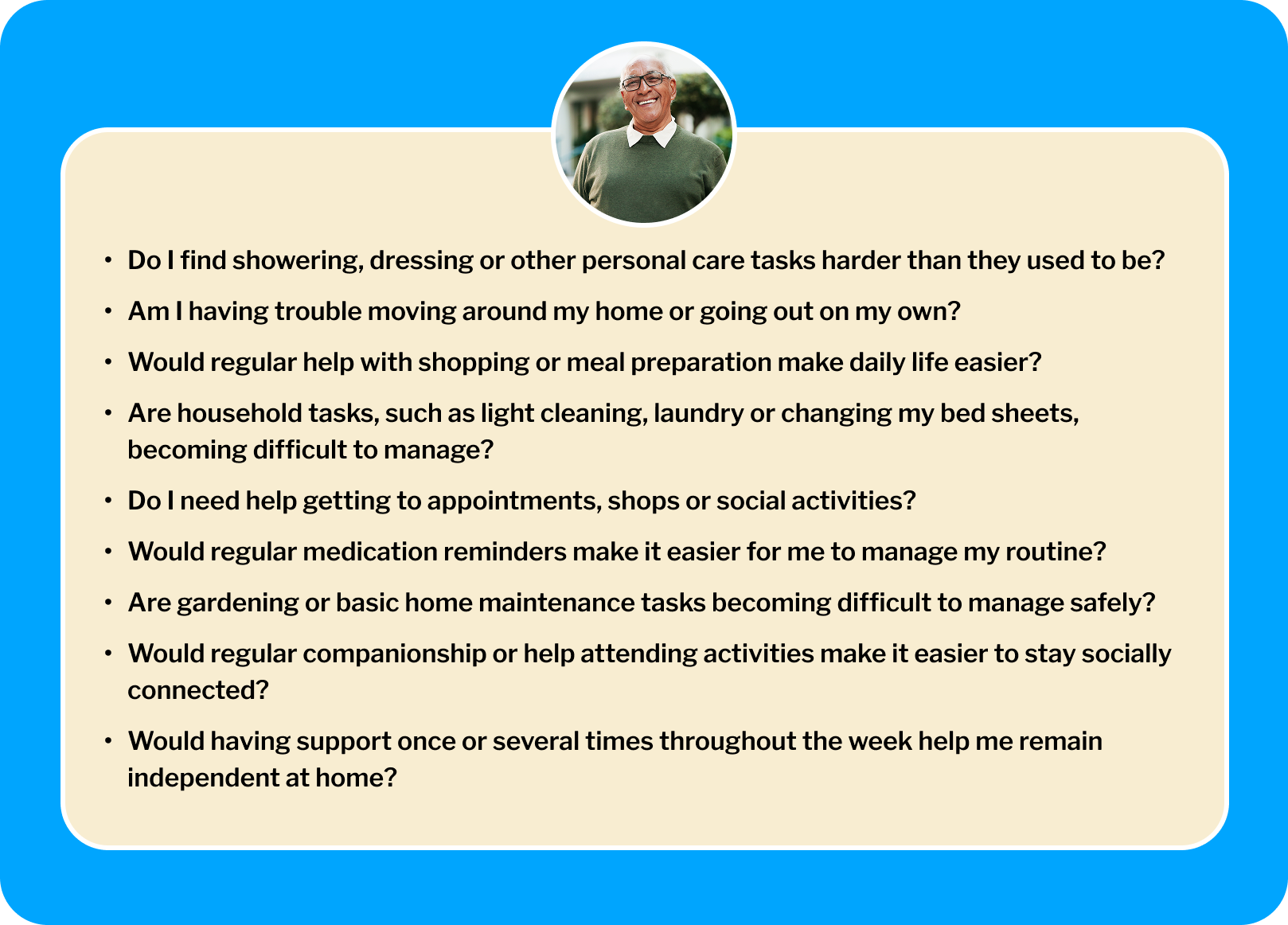
If you answered “Yes” to several of these questions, Classification 2 may reflect the type of support you need. However, your aged care assessment will determine the classification that best matches your individual needs, circumstances and goals.
How much funding do I get in a Classification 2 budget?
With Support at Home Classification 2 funding, you’ll receive an annual budget of $16,451 divided into $4,112 quarterly payments.
Key funding points:
- Your total care budget consists of government funding, your contributions and any eligible supplements.
- You may be asked to pay a share of costs based on your income and assets. There’s a $137,917 lifetime cap on care costs (current as of 20 March 2026), so you’ll never pay more than this over time.
- Your care provider can deduct up to 10% of your quarterly budget for care management.
- When wait times for ongoing funding in the Support at Home Priority System are longer than expected, you may receive 60% of your approved funding upfront to access essential services. The rest of your budget will be assigned as soon as funding is available.
- Budgets are indexed each year on 1 July.
How many hours of support can I get with Support at Home Classification 2?
There isn’t a fixed number of care hours attached to Support at Home Classification 2.
How far your annual budget goes depends on the services you choose and their cost. Factors that can affect your available care hours include:
- The type of services you choose (for example, clinical support services cost more than personal care or transport)
- Your service provider’s prices (hourly costs)
- Whether you’re required to contribute based on your income and assets
- Provider care management fees
Do I have to pay towards my Classification 2 services?
You may need to contribute to your service costs with Support at Home Classification 2 funding, but the amount depends on:
1. Your Income and Assets
- Full Age Pensioner: Minimum contribution
- Part Pensioner / Commonwealth Seniors Health Card holder: Moderate contribution
- Self-Funded Retiree: Higher contribution
As a Support at Home program participant, you will be asked to complete an income and assets assessment (typically through Services Australia) to determine how much you contribute toward your care. While this assessment isn’t technically required to access services, if you choose not to complete one, you may be asked to pay the maximum contribution rate.
2. The Service Category
The Australian government groups aged care services into three categories:
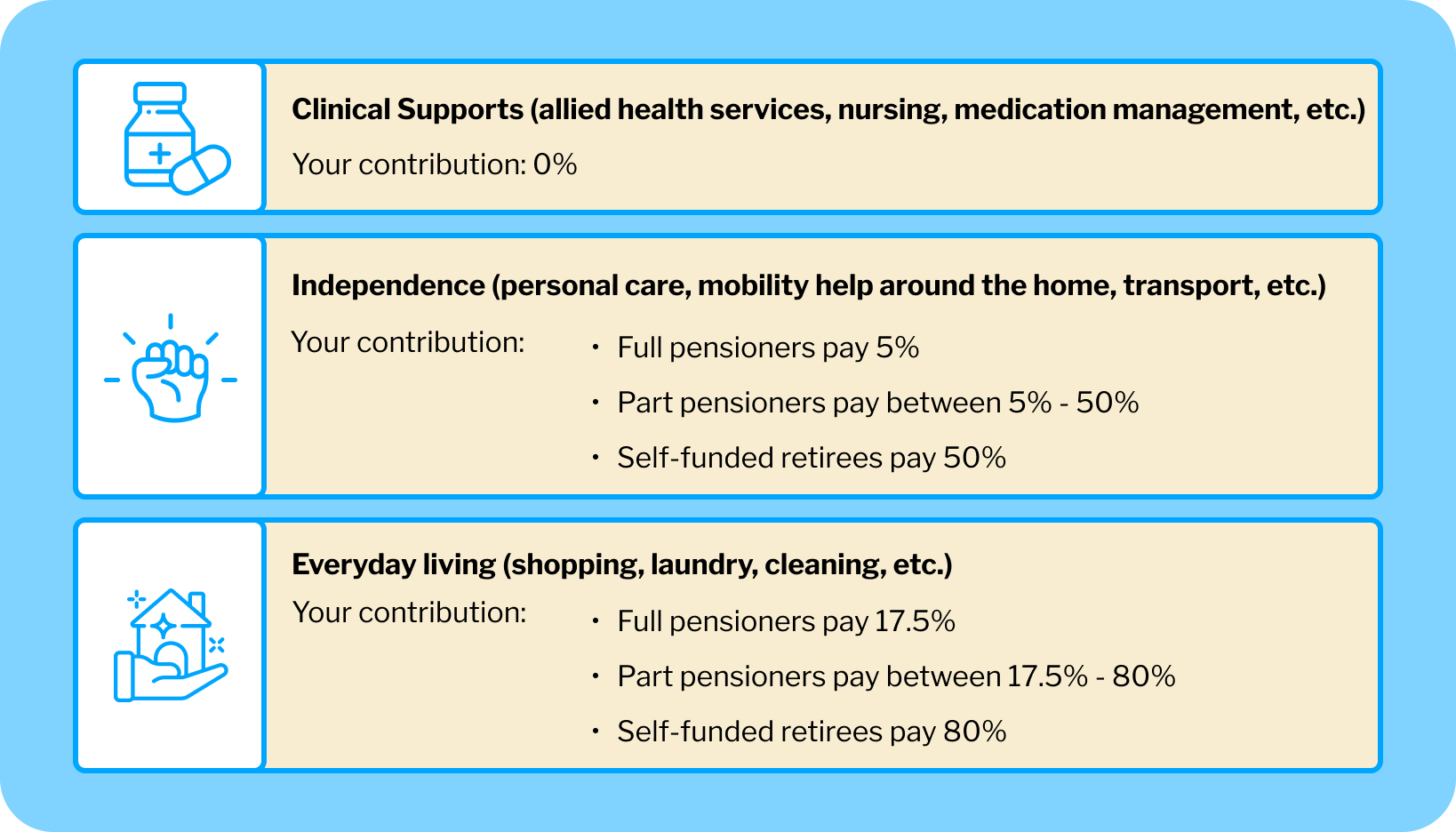
When you put these together, you get an idea of how much you may need to contribute. My Aged Care’s Fee Estimator tool can also help you start planning your Support at Home budget.
What types of services can I get with a Support at Home Classification 2 budget?
Classification 2 gives you a larger budget than Classification 1, which may allow you to arrange more regular support or combine assistance across different parts of your week.
The exact services you receive will depend on your assessed needs and the services approved in your support plan. You may be able to access:

Regular help with:
- domestic assistance, like cleaning, laundry or meal
- preparation
- shopping
- transport
- social support for wellbeing, such as community outings

Regular light and safety-focused maintenance such as:
- lawn mowing
- weeding garden beds
- pruning small shrubs
- sweeping paths and driveways
- basic watering
- trimming low branches for safety
Additional Help
Understanding how your classification translates into actual care isn’t always easy.
If you’d like to discuss Support at Home Classification 2 or explore how you could use your funding with The CareSide, call our team on 1300 854 080.
You can also complete our online enquiry form and one of our Care Consultants will get in touch.

SAH FAQs
How do I access Support at Home Classification 2 funding?
Start by registering with My Aged Care online or calling 1800 200 422.
If you’re referred for an aged care assessment, an assessor will make a time to discuss your health, mobility, daily activities and the types of support you may need at home.
Your assessment outcome determines your Support at Home classification. If you’re approved for ongoing funding, you’ll enter the Support at Home Priority System until funding becomes available.
Once your funding has been allocated, you can choose a home care provider and start organising the services included in your support plan.
How is my Support at Home classification decided?
Your classification is based on your aged care assessment. The assessor looks at how you’re managing in different areas of daily life, including your mobility, personal care, health, home environment and ability to complete everyday tasks.
They then use the assessment outcome to determine which Support at Home classification most closely matches the level of assistance you need.
How is my Classification 2 budget managed?
You receive your Classification 2 funding as a quarterly budget. You and your provider will decide how to use your available funding across the services approved in your support plan. These services must be included on the government’s Support at Home service list.
Your provider will also give you monthly statements showing the services you’ve used, how much has been spent and how much funding remains.
Can unused Classification 2 funding roll over?
Yes. If you don’t use your full quarterly budget, up to $1,000 or 10% of your quarterly budget, whichever is greater, can automatically carry over into the next quarter.
What happens if my care needs change?
If you start needing more or different types of assistance, speak with your care provider. In some cases, you may be able to change the mix or frequency of services within your existing support plan.
If your overall level of care has increased, you or your provider can request a plan review or reassessment through My Aged Care. Depending on the outcome, you may be approved for a higher Support at Home classification.
Will my Home Care Package become Support at Home Classification 2?
Not automatically. People who were receiving a Home Care Package when Support at Home began moved to a separate transitioned funding level equivalent to their previous package. Any Home Care Package funds also carried over into Support at Home.
Is Classification 2 the same as a Home Care Package Level 2?
No. Support at Home introduced eight ongoing classifications, while the former Home Care Packages Program had four levels.
Support at Home Classification 2 is a funding level for people assessed under the new program. Transitioned HCP Level 2 is a separate classification for eligible people who moved across from the former Home Care Packages Program.
The two have different funding amounts and shouldn’t be treated as equivalent.
What happens if Classification 2 funding isn’t enough?
If your Classification 2 budget no longer meets your needs, you can ask for your support plan to be reviewed. If your needs have increased, a reassessment may result in approval for a higher ongoing classification, ensuring you continue receiving safe, practical care at home.
Depending on your circumstances, you may also be assessed for additional support through the short-term care pathways. Approval for these options is based on your individual needs and eligibility.
- By Eddie Carroll

- By Eddie Carroll

- By Renee Lunder