


2. Support at Home Assessment and Eligibility
Three groups of Australians are eligible for the Support at Home program:
- People over the age of 65
- Aboriginal and Torres Strait Islander people over the age of 50
- People over the age of 50 who are homeless or at risk of becoming homeless
Assessments for care happen through Australia’s new Single Assessment System and utilise the Integrated Assessment Tool (IAT). The IAT—which was introduced in July 2024—enables assessors to gather essential information about applicants and deliver more tailored service recommendations.
If you are a home care applicant, your assessor will also collaborate with you to develop a care plan based on your needs and goals. Your care plan is the basis for the funding and services you can receive under Support at Home.
3. Prioritisation and Wait Times
The Support at Home program aims to add 300,000 more places over the next 10 years. By 2035, the government expects around 1.4 million Australians to be in care.
Initially, Australians should expect current wait times to carry over into Support at Home. If all goes as planned, wait times will diminish as Support at Home progresses.
The aged care prioritisation system features two key changes under the Support at Home program:
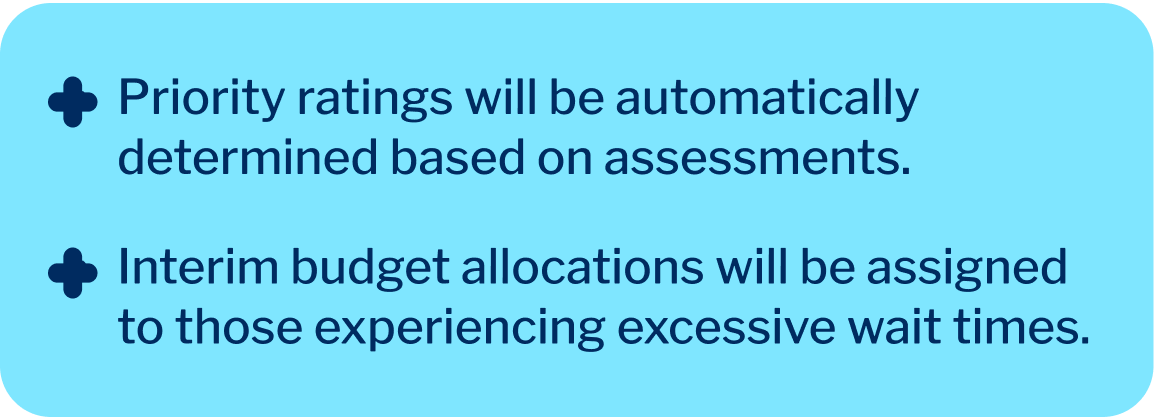
- Priority ratings are automatically determined based on results and responses collected during assessments; every applicant receives a rating tier of High, Medium, or Standard after completing their assessment. This new prioritisation system replaced the National Priority System for Home Care Packages.
- When wait times for services exceed expectations under Support at Home, participants are assigned an interim allocation of their Support at Home classification budget while they wait to receive their full funding. The allocation is 60% of their quarterly budget; the remaining 40% is allocated when funding is available.
4. Support at Home Pricing & Funding
Funding under the Support at Home program is similar to Home Care Packages in two ways:
- The Australian government pays for health-related costs
- Funds for home care services are allocated based on each individual’s care needs
However, under the new system, Australian seniors with financial means may be expected to contribute more.
Support at Home Contribution Arrangements
Under the Support at Home program, you only pay contributions for the services you have received. Your contributions are determined based on the hourly rate for the service or a percentage of the cost of the service type or product. For example, if you receive three hours of personal care, you pay a contribution per hour received.
For items such as consumables, your contribution is calculated as a percentage of the cost.
Ultimately, your contribution rate is determined by two factors: the type of service received and your financial standing.
Type of Service:
- No Contribution — Clinical Supports Category: The government fully funds clinical care (including nursing care and physiotherapy) for all Support at Home participants.
- Moderate Contribution — Independence Category: Supports that help keep you out of hospital and residential aged care (including personal care, assistive technology, and home modifications) require a moderate contribution through 1 October 2026. On that date, the government will fully fund personal care services for Support at Home participants, including showering, dressing, and continence support.
- Highest Contribution — Everyday Living Services Category: Everyday living services such as domestic assistance and gardening require the highest contribution.
Age-Pension Status, Commonwealth Seniors Health Card Status, Means:
- With the Home Care Package program, fee arrangements (the basic daily fee and income-tested care fee) did not vary based on the level of services used. That changed with the Support at Home program—the table below provides a breakdown for full pensioners, part pensioners, and self-funded retirees.
| Clinical supports | Independence | Everyday living | |
|---|---|---|---|
| Full pensioner | 0% | 5% | 17.5% |
| Part pensioner | 0% | Part pensioners and CSHC holders will pay between 5% and 50% based on an assessment of their income and assets. For part pensioners, this will be based on their Age Pension means assessment. CSHC holders will undergo a separate assessment for Support at Home. | Part pensioners and CSHC holders will pay between 17.5% and 80% based on an assessment of their income and assets. For part pensioners, this will be based on their Age Pension means assessment. CSHC holders will undergo a separate assessment for Support at Home. |
| Self-funded retiree (holding or eligible for a Commonwealth Seniors Health Card – CSHC) | 0% | ||
| Self-funded retiree (not eligible for a Commonwealth Seniors Health Card) | 0% | 50% | 80% |
Source: Australian Government Department of Health and Aged
Contribution Arrangements for Current Home Care Recipients
A ‘no worse-off’ principle for contribution arrangements aimed to prevent the 2025 aged care reforms from negatively impacting current home care recipients.
If on 12 September 2024, you were either:
A) Receiving a Home Care Package
B) On the National Priority System
C) Assessed as being eligible for a Home Care Package
…you make the same or lower contributions after the Support at Home transition.
Home Care Package recipients who did not pay an income-tested care fee continued with no such fees under Support at Home. Those who were paying income-tested fees, however, transitioned into Support at Home with special discounted contribution arrangements.
Finally, a cap ensures no individual pays more than $130,000 in non-clinical care costs over their lifetime. This applies to both in-home care and residential care.
5. Support at Home Categories: Classifications & Pathways
Eight levels of support are available under the Support at Home program. The highest level includes a maximum annual funding of up to $78,000 per person, as well as two short-term care pathways. By comparison, the Home Care Package program had four levels of support. Level 4 included a $61,400 maximum.
As with the new prioritisation system, the level of support a participant qualifies for depends on their assessment findings. If you’re already a home care recipient or on the National Priority System, you retain the level of funding of your approved Home Care Package until you are reassessed into a new classification under Support at Home.
| Classification | Quarterly Budget | Annual Amount |
|---|---|---|
| 1 | $2,682.75 | $10,731.00 |
| 2 | $4,008.61 | $16,034.45 |
| 3 | $5,491.43 | $21,965.70 |
| 4 | $7,424.10 | $29,696.40 |
| 5 | $9,924.35 | $39,697.40 |
| 6 | $12,028.58 | $48,114.30 |
| 7 | $14,537.04 | $58,148.15 |
| 8 | $19,526.59 | $78,106.35 |
| Restorative Care Pathway | Funding of around $6,000 for up to 16 weeks. | |
| End-Of-Life Pathway | Funding of around $25,000 for 12 weeks (which can be accessed for up to 16 weeks) | |
Source: Australian Government Department of Health and Aged Care
Support at Home participants also have access to two short-term pathways:
- Restorative Care Pathway: This pathway expanded upon existing arrangements under the Short-Term Restorative Care (STRC) Programme by increasing support from 8 weeks to a maximum of 16 weeks. Participants can utilise this pathway to maintain and improve their independence, delay reliance on additional services, and continue participating in activities they enjoy.
- End-of-Life Pathway: This pathway provides access to additional services in the last three months of life for Australians who prefer to remain living at home during that time.
In addition to those eight levels of support and two short-term pathways, the Support at Home program features three funding tiers for assistive technology and home modifications (AT-HM Scheme)—more on those below.
6. Support at Home Service List
The Support at Home program features a defined service list to specify what’s available in the program. It features three categories:
- Clinical Care, such as nursing care
- Independence, such as help with showering
- Everyday Living, such as gardening and house cleaning
Each category has its own service types and participant contribution arrangements. Assessments determine which services are available to home care recipients, and those determinations are documented in their accompanying support plans.
If you’d like to learn more about the Support at Home service list and what services might be available to you, view pages 17–32 in the Support at Home Program Handbook.
Support at Home Capped Prices
Capped service prices will be another major change under Support at Home. The government will set price caps for each service type, and home care service providers will not charge unit prices over those caps. Providers will invoice the Australian Government for services delivered against each care recipient’s budget. An implementation date for price caps has yet to be determined.
The Independent Health and Aged Care Pricing Authority (IHACPA) will advise on price caps to ensure equitable, fair and transparent pricing of in-home care services. Price caps will include the full cost of service delivery, including administration costs—meaning aged care providers won’t be able to charge separate administration fees.
Support at Home Quarterly Budget
Under Support at Home, your annual subsidy amount is divided into four equal quarterly budgets, with each covering three months of the year. If you don’t spend your entire budget within a single quarter, you can move unspent funds of up to $1,000 or 10% of your quarterly budget (whichever is greater) between quarters to meet unplanned needs. Your budget is held in an account managed by Services Australia.
7. Assistive Technology and Home Modifications Scheme (AT-HM)
Here’s another big change you should know: the Support at Home program provides eligible recipients with separate funding for products, equipment and home modifications to help them remain at home safely and independently.
Support at Home participants deemed to require assistive technology and/or home modifications during their assessment are allocated the necessary funds in their support plan.
If you are a home care recipient, you can share your support plan with your home care provider, and they will arrange and source the required products, home maintenance modifications, and services (e.g. setup and training to ensure safe and proper use of equipment).
AT-HM Funding Tiers
There are three funding tiers for assistive technology and three tiers for home modifications. Each tier has a set time period during which funding must be used; AT-HM funding does not accrue over time.
Funding can include up to $15,000, though Support at Home participants may be required to provide co-contributions toward their assistive technology or home modifications.
Much like the Support at Home service list, the AT-HM Scheme provides clear guidance on what products, equipment and modifications are available.
| Assistive Technology Funding Tier | Funding allocation cap | Time allocated to expend funding |
|---|---|---|
| Low | $500 | 12 months |
| Medium | $2,000 | 12 months |
| High | $15,000* | 12 months |
| *Higher amounts for AT may be approved with prescription. | ||
Source: Australian Government Department of Health and Aged Care
| Home Modifications Funding Tier | Funding allocation cap | Time allocated to expend funding |
|---|---|---|
| Low | $500 | 12 months |
| Medium | $2,000 | 12 months |
| High | $15,000 | 12 months |
Source: Australian Government Department of Health and Aged Care
The Support at Home Program Overview Summary
Do you still have questions about the Support at Home program?
That’s okay!
This is a time of transition for all of us, but as always, the primary goal is to ensure you and your family feel supported. The CareSide team is a reliable resource as Australia shifts toward the new Support at Home program, so please contact us with questions about the new system.
Here are some easy ways to get in touch:
- Complete a form on our website
- Call us at 1300 85 40 80
- Follow us on Facebook, Instagram and LinkedIn
- Check out more of our Support at Home content: