


Finding the right aged care support for your needs starts with having a plan. Even if you don’t require help at home yet, but expect to in the future, planning ahead ensures all the pieces are in place when you’re ready to take that step.
Home care in Australia is a consumer-directed marketplace, with many care services available. That means you have choice and control over the support you receive. But it can also be an overwhelming process, especially as the country transitions away from legacy programs such as Home Care Packages (HCP) and the Commonwealth Home Support Program (CHSP) to the new Support at Home program.
It’s a question many seniors are asking: ‘What is the best home care option for me?’
The best option for your wellbeing today might not be the best one a year from now. That’s why it’s essential to have a plan and understand all the choices at your disposal. In this guide, we’ll review the current aged care landscape, then examine the most popular options in more detail.
The Aged Care Landscape in 2026
There is a wide range of in-home aged care services available to help you remain safe and independent in your own home. In 2026, the Commonwealth Home Support Program (CHSP) and the Support at Home program are the two main government-funded programs. CHSP is best suited for people with low-level care needs, while Support at Home is more comprehensive and built for ongoing support. We’ll cover both programs in detail shortly.
Other aged care options include transition care, respite care, flexible care services, and initiatives designed for specific conditions such as dementia. Ultimately, the best choice for you comes down to your unique care needs and goals.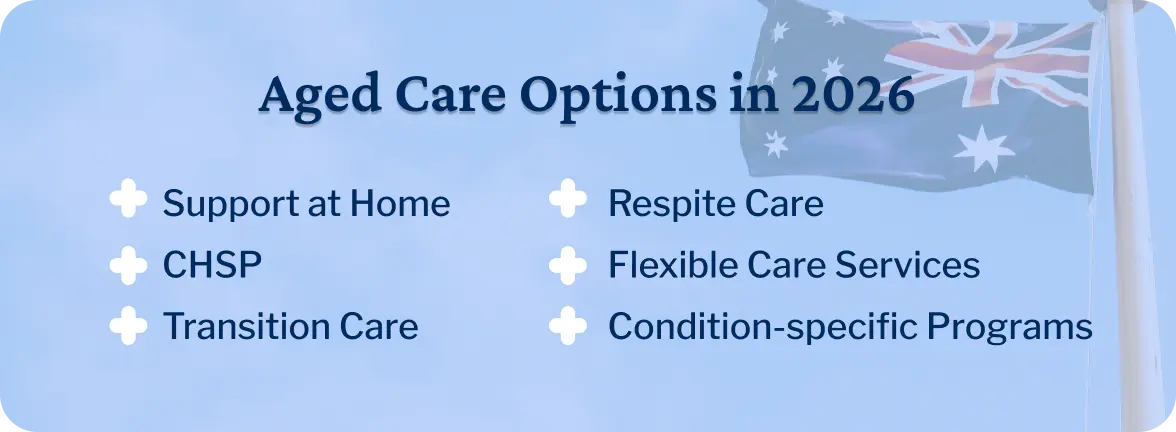
As you navigate your aged care journey, there are two variables you’ll want to consider from the start: access and cost.
Access
What services can you access? The best way to know for sure is to get an aged care assessment through My Aged Care. Many government-funded programs require this as an initial step, including CHSP and Support at Home. You can use My Aged Care’s online eligibility checker to confirm you meet the requirements for an assessment before applying.
If you’re comparing CHSP and Support at Home, specifically, you’ll likely have to choose one or the other once your assessment is finalised and you’re approved for support. However, some exceptions apply. In certain circumstances, people receiving Support at Home can access short-term or time-limited CHSP services in addition to Support at Home services. Exceptions include pre-existing social group activities, hoarding and squalor assistance, some respite services, and access to emergency services.
Cost
How much will your care services cost?
The cost of home care varies based on several factors, such as the type of help you need, your home care provider, your income and financial situation, and the program you access. Some programs, such as Support at Home, utilise income and means assessments to determine participant contributions.
The government subsidises many types of aged care, helping care recipients limit their financial responsibility.
Every provider listed on My Aged Care’s Find a Provider tool offers government-subsidised care, so that’s a trustworthy place to begin your research. Just remember: pricing and fees can vary significantly between providers. Be sure you understand all of the costs and fees up front before you commit to a particular aged care provider, and visit My Aged Care to learn more about how costs work.
Support at Home vs. CHSP: Key Differences
While many home care options are available, the Commonwealth Home Support Program and Support at Home are currently the primary ones subsidised by the Australian government. So how do they differ?
- CHSP is designed for older Australians with low-level care needs. It is an entry-level program, and it’s typically the first step people take when they need a little extra help at home. If you need assistance with a few tasks for a few hours per week, but you’re otherwise managing safely on your own, then CHSP is a good starting point. CHSP does not feature income or means assessments—participants make small financial contributions to their services, but the government subsidises the rest.
- Support at Home is for seniors with more complex and ongoing needs. It’s designed to help older Australians live safely and independently with regular assistance for everyday tasks. There are eight funding classifications, multiple short-term care pathways, and a defined service list, with each service falling under a specific category. An income and means assessment determines the financial contribution you’re expected to make toward your services.
The differences may seem straightforward, but there are other variables that make the comparison a bit tricky. As you weigh your options and formulate a care plan for yourself—not only for today, but for the future—keep in mind:
- CHSP will be phased out: Support at Home is Australia’s primary in-home care system. It replaced the Home Care Package program and short-term restorative care program on 1 November 2025, and CHSP will transition to Support at Home in 2027.
- CHSP will have growing limitations: As this transition continues, CHSP providers and services are expected to become more difficult to access—especially for new participants who haven’t previously received care in the CHSP program. Since Support at Home is now the country’s primary method of aged care service delivery, it will have an increasingly robust selection of providers and services to choose from.
That’s not to say, however, that CHSP isn’t a viable option. Many older Australians still rely on it, and it may still be right for your situation. With that in mind, let’s break down CHSP and Support at Home piece by piece.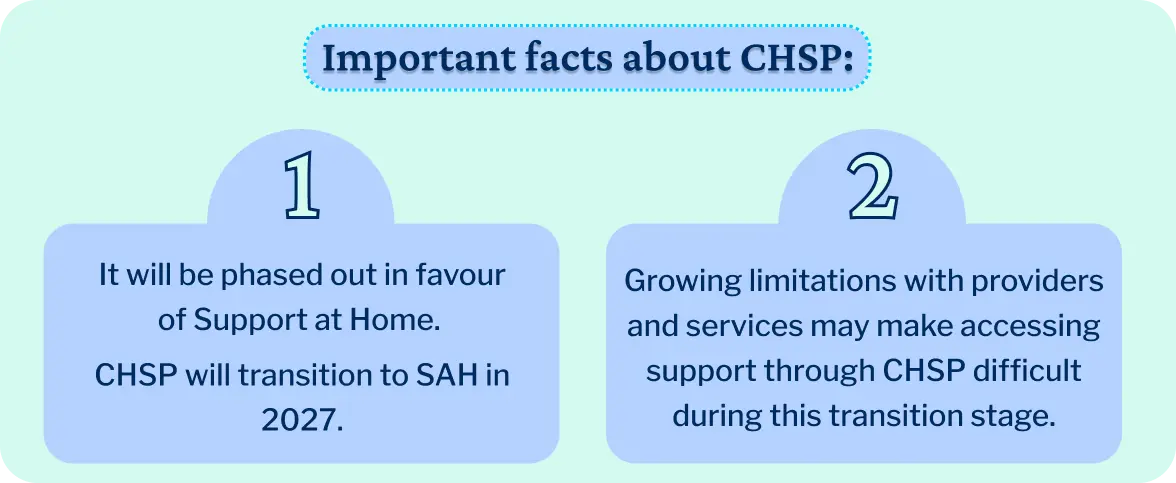
Commonwealth Home Support Program (CHSP)
CHSP Eligibility
To be eligible for Commonwealth Home Support Program services, you must meet one of the following criteria:
- 65 years or older
- An Aboriginal or Torres Strait Islander person and at least 50 years old
- Homeless, or at risk of homelessness, and at least 50 years old
CHSP Assessment
An aged care assessment is required to access CHSP services. Before applying, you can learn if you meet the requirements for an assessment by visiting My Aged Care.
If approved, you’ll receive a letter detailing which services you are eligible for. This includes any approvals for short-term care, which will depend on your assessed needs.
Approval also means you can connect with suitable providers and choose the best one for your needs. Keep in mind, though, that provider availability can vary by location. Wait times are common, so it’s best to create a list of viable providers just in case your first choice isn’t feasible. Visit My Aged Care to learn more about connecting with CHSP providers.
CHSP Services
The support services available under CHSP are entry-level and meant to assist with everyday tasks. Examples include nursing care, personal care, allied health and therapy, minor home adjustments, transport, and meal preparation and delivery.
CHSP Providers
To ensure CHSP participants can access the basic support they need at affordable prices, the government subsidises organisations across Australia to deliver CHSP care services. If you require multiple services, you can use different CHSP providers for each one. Explore the Find a Provider tool on My Aged Care to learn about the options near you.
CHSP Costs
Once you’re approved for CHSP services and find a suitable provider, you’ll discuss costs with the provider and agree to terms before starting services. While CHSP providers set their own prices, government funding ensures participants are not required to pay the full cost.
Again, there is no income and means assessment with CHSP; your financial contributions will go directly to your provider. Simple services, such as house cleaning, might only cost a few dollars, while more complex tasks, such as home modifications, can cost significantly more.
Support at Home Program (SAH)
Support at Home Eligibility
To be eligible for Support at Home services, you must meet one of the following criteria:
- 65 years or older
- An Aboriginal or Torres Strait Islander person and at least 50 years old
- Homeless, or at risk of homelessness, and at least 50 years old
Support at Home Assessment
An aged care assessment is required to access Support at Home services. Before applying, you can learn if you meet the requirements for an assessment by visiting My Aged Care. The assessment will determine your support classification and what services best meet your ongoing or short-term needs.
If approved, you’ll receive a ‘Notice of Decision’ letter detailing which services are available to you. This includes any approvals for ongoing or short-term care, depending on your assessed needs. Once your funding becomes available, you can choose a Support at Home provider and discuss with them the mix of services that aligns with your needs and budget. You can request to change this service mix at any time. You can also request reassessment if your needs change.
Keep in mind: approval doesn’t necessarily mean you can begin services immediately. Wait times continue to affect the aged care sector, though the new program aims to address that issue. Your wait time will depend on the date of your approval, your priority category (urgent, high, medium, or standard), and if you’re approved for a short-term pathway. The higher your priority category, the less time you will have to wait to start receiving your approved funding.
You might also be eligible for interim funding. When wait times for ongoing funding in the Support at Home Priority System are longer than expected, you may receive 60% of your approved funding so you can access essential services while you wait for your full allocation. The rest of your budget will be assigned as soon as funding is available.
Support at Home Services
If you are approved to receive ongoing Support at Home services, you will be assigned one of the eight classifications and the corresponding funding amount. You may also qualify for one of the program’s short-term care pathways, such as restorative care or the Assistive Technology and Home Modifications Scheme (AT-HM). The third pathway, the End-of-Life pathway, is for care recipients who have three months or less to live and who wish to remain in their home during that time.
There is a defined service list organised into three categories: Clinical Supports, Independence, and Everyday Living. You can only access services you were approved for during your assessment. Examples include nursing care, personal care, social support and community engagement, in-home physiotherapy, domestic assistance, and more. Visit My Aged Care to learn more about Support at Home services.
Support at Home Providers
There are several ways to find a Support at Home provider:
- Ask your assessor to refer you to a local provider, who will then contact you directly
- Use the My Aged Care Find a Provider tool to browse local providers that match your needs
- Call My Aged Care on 1800 200 422 for guidance
While contacting providers, it’s helpful to have your approval letter handy to confirm they deliver the services you’ve been approved to receive.
When your government funding is available, you’ll receive a second letter informing you that you’ve been allocated Support at Home funds. From that date listed on the letter, you’ll have 56 calendar days to find a provider and sign a service agreement. If you need more time, you can ask My Aged Care for a 28-day extension. Visit My Aged Care to learn more about connecting with Support at Home providers.
Support at Home Costs
Your Support at Home costs will mostly depend on two factors: your contribution and your provider’s prices.
As a Support at Home program participant, you will be asked to submit an income and means assessment (typically through Services Australia) to determine how much you contribute toward your care. While this assessment isn’t technically required to access services, if you choose not to complete one, you may be asked to pay the maximum contribution rate.
Under Support at Home, older Australians with financial means are expected to contribute more. If you’re required to contribute toward your services, the government pays the remaining portion of your care costs directly to your provider. Two important things to know:
- The government fully funds services under the Clinical Care category (including physiotherapy, nursing care, and occupational therapy).
- Services under the Independence category (such as personal care, assistive technology, and home modifications) require a moderate contribution, while Everyday Living services (such as domestic assistance and gardening) require the highest contribution.
My Aged Care’s Fee Estimator tool can help you get an idea of what you might need to contribute so you can start planning.
Starting 1 July 2026, the government will set price caps for each service type, meaning home care service providers won’t be able to charge above those limits. Until then, providers can set their own prices, but they must publish clear pricing information for the services they provide. Providers must also agree with you on pricing for your services in advance. If prices change, they must inform you why the changes are occurring and when they’ll take effect.
Support at Home Budget
Your budget will consist of your contributions, government funding, and supplements you’re eligible to receive. Annual subsidy amounts are divided into quarterly budgets, with each covering three months of the year. You can carry over unspent funds to the next quarter, up to $1,000 or 10% (whichever is greater).
Your Support at Home service provider is required to develop an individualised budget to help you make the most of your funding and support.
Aged Care FAQs: Choosing the Best Program for You
Choosing the right program involves weighing several factors, from your current needs to how those needs might change over time.
With that in mind, here are a few of the most common questions home care recipients are asking as they navigate their options:
Why take up low-level Support at Home funding when I can use CHSP instead?
The biggest reason is that CHSP is ending in 2027, and as the program is gradually phased out, finding (and retaining) CHSP providers is becoming more difficult. If consistent, long-term support is important to you, and if you think you might need additional services in the future to maintain your independence, Support at Home is likely the more future-proof option.
Keep in mind that Support at Home also enables you to receive different services under every service category (Clinical, Independence, and Everyday Living), while CHSP limits access to one or two services per provider. If you are a CHSP participant with multiple home care needs, you might need to coordinate multiple providers, which can be a care management headache for you or your loved ones. These constraints can become cumbersome as your needs evolve, and the flexibility of Support at Home makes it easier to access different services as your situation changes.
My budget is tight. Are my co-contributions worth it under SAH?
If you’re contemplating whether your SAH co-contributions will be worth it, ask yourself:
- What does my present and future look like with and without home support?
- What are my personal goals?
- What do I want daily life to look like? What happens if I’m not receiving the support I need?
Perhaps this reflection helps you realise that you don’t need aged care services just yet. However, if you think you might need such services in the future, it’s a good idea to start the process early to avoid delays, wait times, or unexpected stress when circumstances change.
Should I wait until my income assessment is complete before moving forward as a participant in the Support at Home program?
This is a matter of personal preference, but it’s generally best to start the process earlier rather than later to ensure you have care when you need it. Maybe that need isn’t immediate, but having plans in place can make a big difference if your situation changes unexpectedly.
You can get your income and assets assessed at any time, even before you enter care. If you’re already discussing services with your chosen provider, for instance, you can work with them to develop a framework for your care and budget while you wait for Services Australia (or another organisation) to complete your income and means assessment. Two things to keep in mind:
- The fee advice letter you’ll receive once your assessment is complete is only valid for 120 days from the date of your assessment. If you don’t enter care during that period, you will need to complete another assessment.
- My Aged Care’s Fee Estimator tool can help you get an idea of what you might need to contribute so you can start planning.
Additional Home Care Resources
Here are some additional resources to help you find the best aged care support for your needs:
- Financial Guidance: Aged care finances can be complex, and there are many things to consider, such as pensions, superannuation, and retirement planning. Visit My Aged Care for financial support and advice.
- Cost Concerns: Financial hardship assistance is available for older Australians who may not be able to afford home care. Visit My Aged Care to learn more.
- Support at Home E-book: The Support at Home program has introduced many new variables into aged care, which is why we created this Support at Home E-book—free to download and yours to keep.