


The Nun Study Origin
David Snowdon didn’t plan to alter the course of Alzheimer’s Disease research. In fact, he didn’t intend to study the disease at all.
In 1986, Snowdon was an assistant professor of epidemiology at the University of Minnesota, and in his words, he was ‘struggling mightily’ to find his academic niche. Scientific research is a competitive field, and Snowdon knew he had to demonstrate his value quickly.
During his pursuit of a worthwhile research project, another graduate student (and ex-nun) told him about the ageing sisters living out their retirement years at her former convent. The opportunity struck a chord with Snowdon: he’d already spent time studying various religious groups, and he knew the convent could be an optimal place to conduct an epidemiological study.
Why a convent?
Epidemiology is the study of health and disease in defined populations. A convent of retired nuns presented Snowdon with an ideal laboratory of homogeneous lifestyles—the economic status, health care, and overall living conditions were essentially uniform across the convent’s population, and such an environment promised to produce untarnished data.
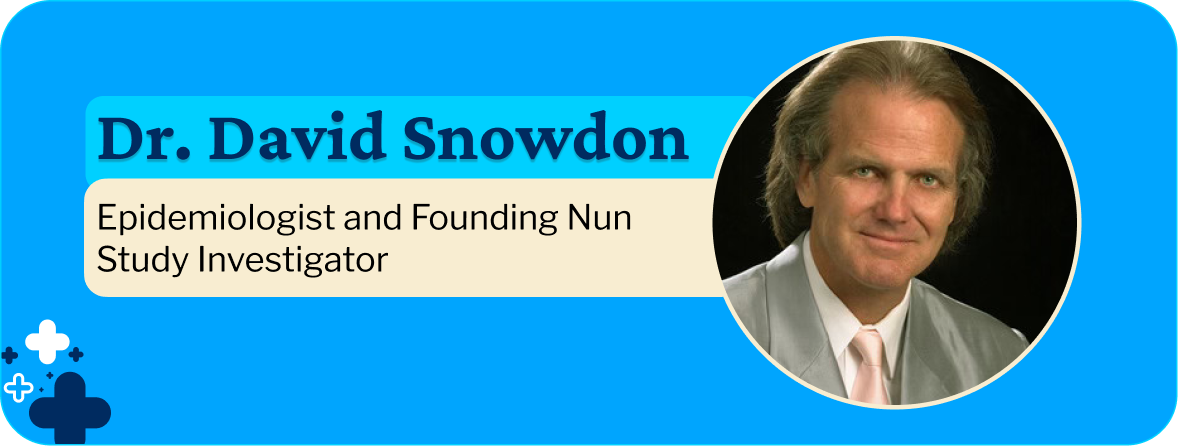
Snowdon ventured to Mantako, Minnesota (USA) and visited the School Sisters of Notre Dame, where he met the convent’s population of Catholic nuns and eventually launched a pilot study on ageing and disability.
It was a broad topic. Snowdon didn’t know what aspect of ageing to focus on, so he visited the convent periodically to ask the nuns questions and learn about factors that might be involved in healthy ageing. The study’s early returns weren’t promising, but then something unexpected happened.
Several months into their convent visits, Snowdon and his colleagues accidentally stumbled upon a pair of metal file cabinets that completely altered the direction of their project—and blazed a new path for Alzheimer’s Disease research.
What is Alzheimer’s Disease?
In 1906, a German pathologist named Alois Alzheimer revealed an intriguing discovery to the 37th Congress of Psychiatrists of Southern Germany.
Dr. Alzheimer had identified an ‘unusual disease of the cerebral cortex’ in a woman’s brain, and it caused symptoms of memory loss, disorientation, and hallucinations until her passing. The condition and its accompanying abnormalities were significant discoveries, and several years later, the disease was officially named after Alzheimer.
Today, Alzheimer’s Disease is the most common form of dementia, which itself is an umbrella term.
Dementia isn’t one specific disease, but rather a progressive set of symptoms stemming from disorders in the brain. It can impact memory, cognition, reasoning, behaviour and overall brain function. Alzheimer’s Disease accounts for more than half of dementia cases, but other forms include Lewy Body Disease, vascular dementia and frontotemporal dementia.
Dr. Alzheimer’s pathological discovery occurred in the early 20th Century, but dementia and its varied forms were recognised for thousands of years before that. Age-related mental decline was long considered a ‘normal’ part of ageing until advancements in medicine debunked that belief and began unmasking the neurodegenerative conditions responsible for memory loss, confusion, and other brain disorders once considered standard facets of old age.

In recent years, dementia has become the leading cause of death in Australia; more than 400,000 Australians are currently living with dementia, and that number is projected to double over the next three decades. By 2030, dementia rates are forecast to reach 78 million people globally, making the race for treatments and a potential cure more critical than ever.
Alzheimer’s Disease, specifically, is at the forefront of biomedical research. As a progressive condition, it worsens over time by destroying brain cells and nerves, disrupting the brain’s message-carrying transmitters, and impairing the production of essential chemicals. There is no cure, but promising breakthroughs continue to materialise thanks to the ongoing efforts of scientists worldwide—scientists like David Snowdon.
When Snowdon and his team accidentally discovered those file cabinets at the convent, they knew instantly that they’d struck gold.
The cabinets housed standardised records of all the young women who had taken their vows at the convent. The records not only featured vital details about the sisters’ birthplaces, families, education, and upbringings, but they also included journals and autobiographies written by each sister upon joining the order.
That unexpected treasure trove of information enabled Snowdon to extend his research on ageing well beyond the limited timeframes typical of other age-focused studies. It also equipped him with a way to objectively measure the sisters’ cognitive abilities when they were younger, which meant The Nun Study could proceed entirely unhindered by many of the time-related constraints that usually limit research on ageing.
What did The Nun Study find?
All told, 678 Catholic sisters participated in David Snowdon’s study, ranging in age from 75 to 102 years old. The study began in Mankato in 1986, but by 1990, it expanded to include older members of the School Sisters of Notre Dame living across the United States.
The health and functionality of those 678 sisters varied: some were in their 90s and still working full-time, while others were in their 70s but severely disabled, unable to communicate, and confined to a bed.
Importantly, all of the study’s participants were women. Up to that point, most age-related research had been conducted on white, middle-aged men, even though women make up the majority of the world’s elderly population.
With those precise conditions as the study’s foundation, Snowdon’s research progressed:
- All 678 participants agreed to annual assessments of their cognitive and physical health, including medical examinations and blood tests to analyse genetic and nutritional factors.
- Each participant agreed to donate her brain after death for neuropathologic study. This made the Nun Study the largest brain-donor population in the world. Alzheimer’s Disease is formally diagnosed after death, when doctors can assess the number of lesions in the cortex of the brain.
The sisters gave researchers full access to their convent and medical records—and those accidental archival discoveries made by Snowdown and his colleagues helped establish The Nun Study as a landmark breakthrough in Alzheimer’s Disease research.
The Nun Study Results
Though it began on shaky ground and initially lacked clear direction, The Nun Study ultimately produced a series of findings that altered Alzheimer’s Disease research and continue to inform scientists today.
Education & Idea Density
Using the journals and autobiographies he discovered in the convent’s archives, Snowdon identified a striking correlation between the sisters’ early-life language skills and their likelihood of developing Alzheimer’s Disease later in life.
Those writings—penned by the sisters in their 20s—contained key markers of education level, vocabulary, and general knowledge. By analysing those texts and measuring what researchers refer to as idea density—how much information a sentence contains relative to the number of words used—Snowdon could predict with 85–90% accuracy which women would show brain damage typical of Alzheimer’s Disease decades later.
It was a historic revelation that led to even bigger questions. Were the sisters with strong cognitive abilities somehow protected from developing symptoms of dementia, even when their brains showed physical signs of the disease? Or were the women with simpler writings already suffering from subtle neurological differences earlier in life that predisposed them to cognitive decline later?
Even without definitive answers, The Nun Study appeared to support what other studies had hypothesised: that ‘exercising’ the brain—through continual learning and intellectual activities—can, to some extent, provide resilience to disease-related cognitive decline.
Emotions & Word Choice
While poring over the sisters’ journals and autobiographies, Snowdon and his team examined the emotional tone of the content. They searched for words associated with positive emotions (such as love, hope, gratitude, and contentment) as well as words linked to negative emotions (such as fear, sadness, confusion, and shame). The conclusion here was more definitive: the sisters who expressed more positive emotions in their writings lived longer than those who conveyed more negative ones.
Exercise & Nutrition
Beyond the sisters’ writings, Snowdon and his colleagues investigated lifestyle components, such as diet and exercise habits. Their research showed that participants who engaged in some form of daily physical activity were more likely to retain cognitive abilities at advanced ages. Encouragingly, they also found that participants who began exercising later in life gained the same benefits—even if they hadn’t been physically active earlier in life.
What is cognitive reserve?
The Nun Study was among the first to demonstrate that the clinical symptoms of dementia aren’t always directly tied to a specific brain pathology. In other words, advanced age and the presence of disease do not automatically lead to impaired cognitive ability.
Neuropathologic examinations of the nuns’ brains revealed that many featured the lesions and plaques associated with Alzheimer’s Disease and other forms of dementia. However, not all of those individuals displayed the typical symptoms of those disorders. Why?
The answer may lie in cognitive reserve: the brain’s ability to adapt and continue functioning normally despite damage or disease. The concept of cognitive reserve first emerged in the late 1980s, when The Nun Study was just underway, around the same time David Snowdon was reading the sisters’ journals and beginning to identify links between early-life mental acuity and a lower likelihood of developing Alzheimer’s Disease later in life.
The findings from The Nun Study became a critical addition to that body of research, suggesting that ‘mental fitness’ (i.e., ‘exercising’ the brain) can be a legitimate safeguard against disease. Or, as Dr. Bradley Hyman explained in a 2009 Time article about The Nun Study: ‘In some ways, you could think of it like a trained athlete who might be able to resist some atherosclerosis of the heart.’
Indeed, the human brain is remarkably resilient and adaptable. Even to this day, scientists are still making new discoveries about how the brain functions.
Neuroplasticity—the discovery that the brain can modify its structure and function, even in older age—is one of the most important breakthroughs in modern neuroscience. It overturned long-held beliefs that brains are fixed and unchanging. Such discoveries dispel stereotypes that ‘You can’t teach an old dog new tricks.’ Other famous research projects, such as Ellen Langer’s Counterclockwise Study, reinforce that it’s never too late to learn and evolve.
If The Nun Study’s findings about cognitive reserve continue to hold, the takeaway from decades of research may be relatively straightforward: Exercise is important at every age—not only for the body, but especially for the brain.
The Current State of Dementia
Over the past century, numerous landmark studies have advanced our understanding of Alzheimer’s Disease and dementia.
The Framingham Heart Study (1948–present), for example, revealed strong links between cardiovascular health and dementia risk—reinforcing The Nun Study’s findings regarding the importance of physical exercise and nutrition. Another decades-long project, the Rotterdam Study (1990–present), helped identify genetic and lifestyle risk factors associated with dementia.
Like those efforts, The Nun Study has become a long-running investigation in its own right. In 2001, David Snowdon shared his story with the world when he published Aging with Grace: What the Nun Study Teaches Us about Leading Longer, Healthier, and More Meaningful Lives. Today, four decades after it began, the study remains active at the University of Texas Health San Antonio, where scientists continue studying donated brain autopsy materials and data collected during the nuns’ lives.
The fact that such extensive research is still necessary speaks to the complexity of Alzheimer’s Disease and dementia—it also speaks to the urgency of the situation.
Governments and health organisations worldwide are taking note. In 2017, the World Health Organization (WHO) launched a global action plan to improve the lives of people affected by dementia and mitigate the devastating impact of the disease.
A similar initiative materialised in Australia with the National Dementia Action Plan. Launched in 2024, this 10-year strategy—developed with input from people living with dementia—aims to foster dementia inclusivity by increasing awareness, reducing risk factors, and enhancing dementia support services.
Dementia & Alzheimer’s Disease Breakthroughs
Encouraging breakthroughs continue to emerge from dementia research, including promising new drugs, clinical trials, potential vaccines, and even blood tests designed to detect dementia earlier than before.
Some noteworthy recent efforts include:
Maintain Your Brain Study
Researchers at the Centre for Healthy Brain Ageing (CHeBA) at the University of New South Wales (UNSW) unveiled findings from their Maintain Your Brain Study in 2025. This clinical trial featured more than 6,000 participants aged 55–77 who had multiple dementia risk factors. Participants were divided into two groups: one received personalised online coaching tailored to their risk factors, while the other received standard publicly available health information.
Those who received online coaching were guided through ‘intervention modules’ that focused on four key lifestyle factors, including physical activity, nutrition, brain training, and mental health. By the end of the trial, participants in the coaching group showed measurable cognitive improvements, suggesting that such interventions have legitimate potential to reduce future dementia risk.
Commenting on the encouraging results, study lead Professor Henry Brodaty AO said, ‘The outcome was a resounding yes—we can improve cognition over three years and therefore, likely enhance resilience to dementia.’
Artificial Intelligence
AI is everywhere now. While some developments—such as AI-driven scams targeting older people—highlight the risks associated with the technology, AI is also helping researchers better detect neurological diseases.
For instance, scientists at the University of Cambridge built a machine-learning model that can accurately predict (with more than 80% accuracy) the rate at which a person with mild cognitive impairments will progress to Alzheimer’s Disease. The project’s AI model was about three times more accurate than existing clinical prediction methods.
Meanwhile, researchers at the University of California developed another machine-learning model that can forecast Alzheimer’s Disease up to seven years before symptoms appear, simply by analysing patterns in patient records.
The Nun Study Takeaways
Of course, David Snowdon didn’t have artificial intelligence at his disposal.
What he did have, though, was a convent of compassionate, open-minded nuns and a couple of filing cabinets he found by accident.
In the years since its launch, The Nun Study has remained an integral fulcrum in dementia and Alzheimer’s research. It illuminated the role cognitive function plays in preventing degenerative disorders, and critically, it showed that the pathological presence of those disorders doesn’t automatically translate into clinical symptoms.
Although research is ongoing, lifestyle factors—including exercise, nutrition, and mental ‘fitness’ achieved through continual learning—make a meaningful impact on long-term brain health. Encouragingly, much of the research, from The Nun Study to the more recent Maintain Your Brain Study, suggests that it’s never too late to prioritise and even improve brain health.

The big question is: What does that look like? How can we ensure our brains remain sharp and vigorous well into old age?
For some people, it could mean practising healthy reminiscence; for others, it could mean learning a new language, playing an instrument, reading more books, or even playing brain-stimulating games. The key point is that there’s no single way to keep your brain sharp—choosing activities you enjoy and doing them consistently is what counts.
While the rest of us focus on our mental fitness, scientists, researchers, and technology experts will do their part and continue pursuing a permanent solution to Alzheimer’s Disease and dementia-related disorders.
Perhaps AI proves to be the key.
Or, perhaps a cure will emerge by total accident.
That might actually be more fitting—and David Snowdon might agree.