


As home care in Australia continues its transition from Home Care Packages (HCP) to the Support at Home program, care recipients are adjusting to changes in how they receive their aged care services and government funding.
One particularly big change is the new funding classification levels. Home Care Packages had four funding levels, but Support at Home features eight. The new funding classifications serve similar purposes to the old Home Care Package levels because they:
- Support you to live at home longer
- Match funding amounts to your care needs
- Escalate your funding as your needs change
They also offer greater flexibility, enabling you to tailor your care more precisely to your situation. Importantly, there’s a clear separation between ongoing funding (the eight levels covered here) and targeted short-term pathways (restorative care, end-of-life care, and assistive technology and home modifications).
When you’re assessed as eligible for the Support at Home program, you’ll be assigned one of the eight classifications based on your needs. Generally, the more complex your needs, the higher your Support at Home classification level. If your needs change at any time, you can request a reassessment of your classification level via My Aged Care or your provider.
What are the 8 Support at Home funding classification levels?
Support at Home classifications range from basic care needs (Funding Classification 1) to high and complex care needs (Classification 8).
Each funding classification level has a specific budget. It’s defined annually, but delivered and managed quarterly.
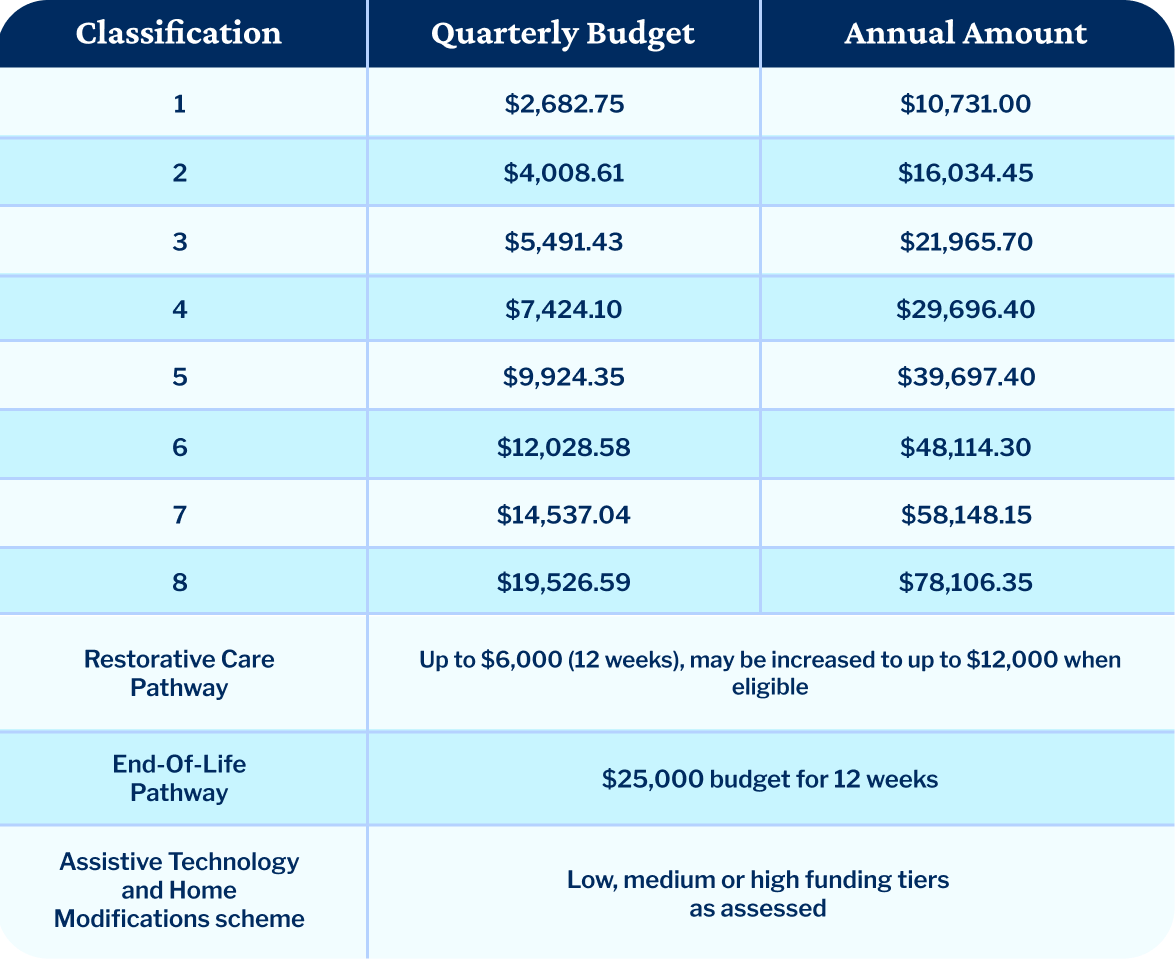
Funding classification 1 is for mostly independent care recipients. It includes occasional support with light home-related tasks.
- Help with shopping or meal preparation
- Light cleaning and laundry
- Basic transport support
Funding classification 2 is for care recipients who need more regular support and includes light personal care.
- Medication reminders
- Showering and dressing support
- Shopping, errands and transport
- Companionship and social support outings
Funding classification 3 is for care recipients who require more structured support multiple times per week.
- Personal hygiene and mobility assistance
- Regular cleaning and laundry
- Transport to medical appointments
Funding classification 4 is for care recipients who need help with personal and household tasks almost daily.
- Daily help with personal hygiene
- Meal support, including meal delivery
- Continence support
- Home safety assessments
Funding classification 5 is for care recipients with intensive daily care needs.
- Daily personal care, including catheter hygiene and medication management
- Physical and mobility aids support, such as walkers
- Transport to medical and allied health appointments
Funding classification 6 is for care recipients with significant health conditions and includes regular nursing and personal care.
- Multiple care visits each day
- Regular nursing, including clinical care
- Home modifications
Funding classification 7 is for care recipients who require multiple daily visits from a coordinated care team.
- Assistance with all daily living activities
- Allied health, nursing and personal care supports working together
- Respite for family carers
Funding classification 8 is for care recipients who require the most intensive in-home care and clinical supports, including older people with advanced, chronic, or terminal illnesses.
- Palliative care support (symptom relief, emotional support and practical help with tasks such as preparing legal documents)
- Care coordination
- Complex equipment and comfort supports
- Rapid response to health changes
In addition to the eight funding classifications, Support at Home also features three short-term care pathways that may be added to your care plan based on the outcome of your assessment.
- Restorative Care Pathway: Coordinated, intensive allied health and/or nursing services to help with recovery from an illness or injury
- Assistive Technology and Home Modifications (AT-HM) Scheme: Separate funding for products, equipment and home modifications
- End-of-Life Pathway: Dedicated funding for services to support older Australians who wish to remain at home in their last three months of life
How is my classification level assessed?
The Australian government determines your funding classification level during your aged care assessment. An assessor will visit you at your home and ask you questions about your daily life.
They will likely cover topics such as your:
- physical health
- mobility
- cognitive function
- living arrangements
- support networks
- potential risks in your home.
Your answers will help the assessor understand what level of support you need now and what you might need in the future. Based on this, you’ll be assigned a funding classification level. You can learn if you meet the eligibility requirements for an assessment by visiting My Aged Care.
How does SAH funding work?
If you’re approved to receive ongoing Support at Home services, you will be assigned one of the eight classifications and the corresponding funding amount.
Annual subsidy amounts are divided into quarterly budgets, with each covering three months of the year. If you don’t spend your entire budget each quarter, you can carry over $1,000 or 10% (whichever is greater) to the next quarter.
Your Support at Home service provider is required to develop an individualised budget to help you make the most of your funding and support. You’ll work with your provider to choose the best services for your needs from a government-approved list of services.
If you had a Home Care Package previously, you’ll be placed into a transitioned Home Care Package level. This keeps your funding aligned with what you received before the changes under the government’s “no worse off” rule. Your annual budget stays unchanged, and any unspent funds move with you into Support at Home.
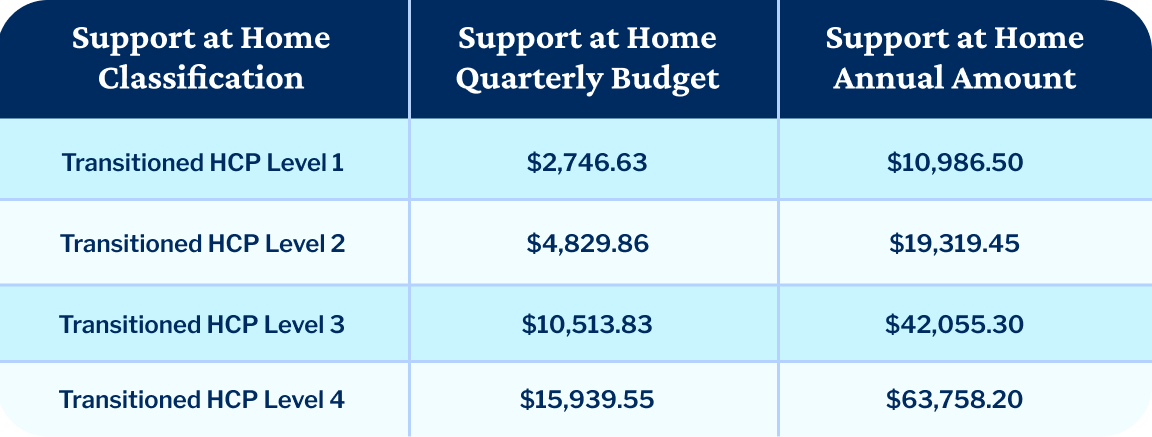
Other key funding points:
- Your total care budget consists of government funding, your contributions and any supplements you’re eligible to receive.
- You may be asked to pay a share of costs based on your income and assets. Note: there’s a $135,318 lifetime cap on care costs (current as of 1 November 2025), so you’ll never pay more than this over time.
- Your care provider can deduct up to 10% of your quarterly budget for care management.
- When wait times for ongoing funding in the Support at Home Priority System are longer than expected, you may receive 60% of your approved funding. This means you can access essential services while you wait for your full allocation. The rest of your budget will be assigned as soon as funding is available.
- Budgets are indexed each year on 1 July.
You might be wondering, ‘How many hours of support can I get for my classification level?’ The answer depends on numerous factors, including your funding classification budget, the services you choose, service pricing, whether you’re a full pensioner, part-pensioner or self-funded retiree, and contributions you make based on your income and assets.
These variables differ from person to person, but My Aged Care’s Fee Estimator tool can help you get an idea so you can start planning your budget.
What does my Support at Home classification funding cover?
Your SAH funding can only be used on services that directly help you live at home safely and independently. Examples include:
- Personal care
- Nursing care and health care visits
- Home help and domestic assistance
- Meal support
- Transport to appointments
- Care coordination and planning
- Allied health
- Carer respite
Funding cannot be used for everyday expenses, such as monthly rent. It also won’t cover:
- Medical procedures or medications covered under
- Medicare or the PBS
- Social activities (unless they support a care goal, such as preventing isolation)
- Entertainment or lifestyle extras (i.e. club memberships or holidays)
- Major home renovations that aren’t directly linked to your care

Support at Home Resources
Adjusting to the new funding classifications may take a bit of time, but hopefully, this article gives you a better understanding of your funding tier and the services available to you under the Support at Home program.
Be sure to communicate with your provider to maximise the support you receive from your funding, and if you have any questions, fill out a quick enquiry form and our team will be in touch.
Here are some additional Support at Home resources you might find useful: