


Aged care in Australia underwent major changes in 2025.
The government introduced a New Aged Care Act that promises to prioritise care recipients’ rights, reform outdated legislation, and place older people at the centre of the aged care system by giving them more choices and control over their care.
The New Act aligned with the launch of the new Support at Home program, altering the landscape of a system that had grown overly confusing and complex.
Of course, the hope is that these changes will help the system run smoother in the long run, but as of now, many home care recipients and their families feel like they have more questions than answers—especially about Support at Home pricing and home care costs. In this article, we’ll break down the new Support at Home pricing arrangements so you can make informed decisions about your in-home aged care with confidence.
What is the Support at Home program?
The Support at Home program is Australia’s in-home care system. It replaced the Home Care Package program (HCP) and short-term restorative care program in November 2025, and the Commonwealth Home Support Program (CHSP) will transition to Support at Home no earlier than July 2027.
Similar to Home Care Packages, Support at Home is a government-funded initiative designed to help older Australians live safely and independently in their own homes for longer. It offers a range of aged care services tailored to individual needs, from personal care and domestic assistance to nursing and allied health services.
But Support at Home differs from Home Care Packages in numerous ways, starting with the levels of support available and the contributions you’re expected to make toward your care.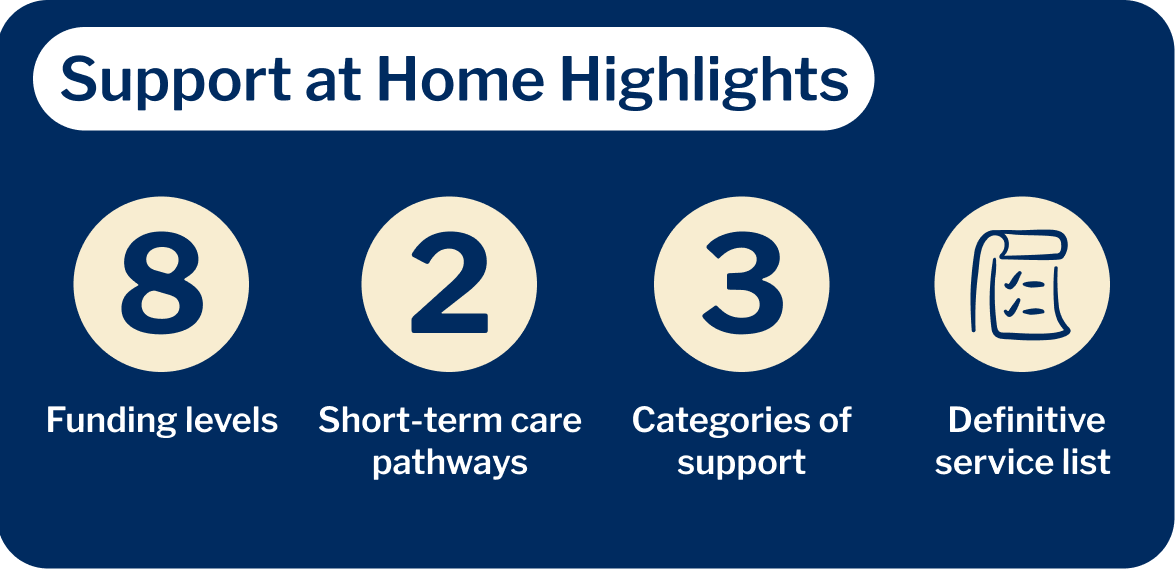
Funding Levels
Whereas the Home Care Package program offered four levels of care, Support at Home aims to be more nuanced with eight funding levels and two new short-term care pathways (Restorative Care and End-of-Life).
Your specific funding level is determined during the assessment process. The level you receive determines the total subsidy provided by the government, which in turn affects your individual contribution. Australians who were receiving services when Home Care Packages transitioned to Support at Home retained the equivalent funding level under the new program.
Contribution Arrangements
Ultimately, your Support at Home contribution rates are determined by two factors: your financial standing and the type of service(s) you receive. Three categories of support are available: Clinical Care, Independence, and Everyday Living.
- Clinical Supports (No Participant Contribution): The government fully funds clinical care (including nursing care and physiotherapy) for all Support at Home participants.
- Independence (Moderate Participant Contribution): Supports that help keep care recipients out of hospital and residential aged care (including personal care, assistive technology, and home modifications) require a moderate contribution.
- Everyday Living (Highest Participant Contribution): Everyday living services, such as domestic assistance and gardening, require the highest contribution.
Under Support at Home, you only pay contributions for the services you have received. Those contributions are determined based on the hourly rate for the service and a percentage of the cost of the service type or product. For example, if you receive three hours of personal care, you will pay a contribution per hour received. Visit this Support at Home Participant Contributions page for a more in-depth breakdown.
With your contribution arrangements and funding level established, the final piece of the puzzle is the service(s) you receive from your home care provider.
Support at Home Pricing: Service Rates Breakdown
Support at Home features a definitive list of government-subsidised services grouped into those three aforementioned categories: Clinical Care, Independence, and Everyday Living. Each category has its own service types and participant contribution arrangements, with the intention of creating more transparency about what is and isn’t covered under the new program.
Your home care provider delivers the services you’re approved to receive, just like with the Home Care Package program.
But unlike Home Care Packages, care recipients are not automatically eligible for services under Support at Home; they must be assessed as needing a service to receive it. That is a significant departure from the previous system, but it’s not the only big service-related change.
Service Pricing Arrangements
While the government sets contribution and funding levels, individual service providers determine their specific service rates within those frameworks—at least for now.
Under Support at Home, service rates account for the total cost of delivering quality care, which includes staffing, administration, and overhead. Importantly, starting on 1 July 2026, the government will set price caps for each service type, and home care providers will not charge prices over those caps. This is another major departure from the previous system.
Price caps aim to ensure fair and transparent pricing across the industry. They will encompass the full cost of service delivery, including administration costs. Even though government-set caps on each service type won’t begin until later, some of these changes took effect when the Support at Home program started:
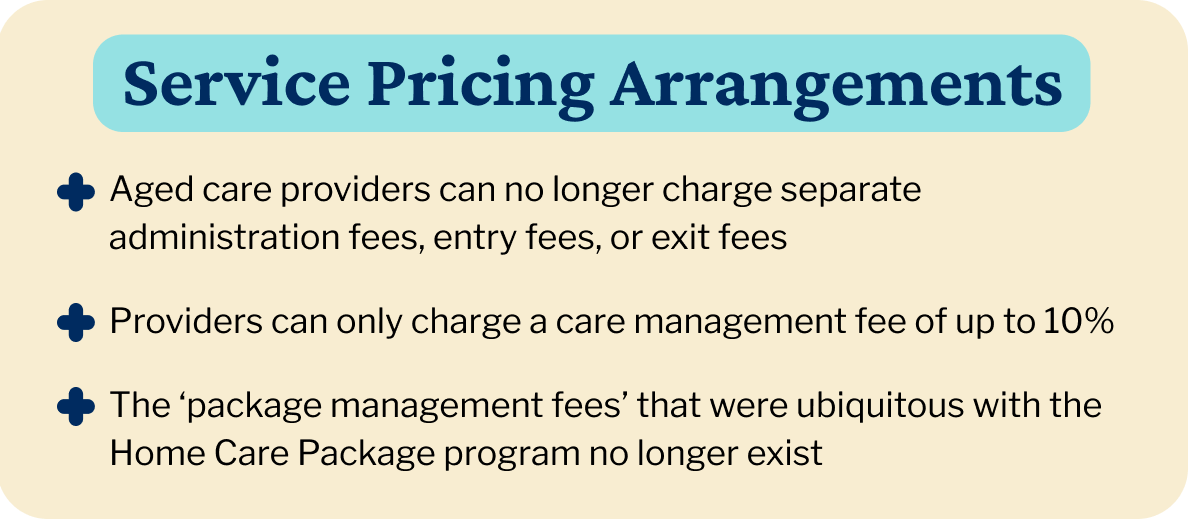
- Aged care providers can no longer charge separate administration fees, entry fees, or exit fees
- Providers can only charge a care management fee of up to 10%
- The ‘package management fees’ that were ubiquitous with the Home Care Package program no longer exist
Because of this shift from ‘many small charges’ to a ‘single bundled rate,’ Australians are noticing higher hourly service rates than they’re used to—even though some unseen expenses (travel, administrative, package management, etc.) were likely already baked into the costs being covered by their Home Care Package.
Perhaps you’ve noticed this increase in home care service rates since the start of Support at Home. Let’s break it down further.
Why are Support at Home service rates so high?
Simply put, many aged care providers in Australia are now charging more for their services because that’s what they have to do to cover their operating costs. For most providers, operating costs have risen due to the increase in administrative compliance they need to keep up with under Support at Home.
Before the Support at Home program, the government didn’t cap ‘package management fees,’ and many providers charged 30% to 40% in fees. Broadly speaking, if you think about it like a balance scale, fees were often the heavier side of the equation.
The advent of Support at Home has caused a lot of confusion in this regard: care recipients are noticing higher service rates and don’t understand the reason, and in many cases, that’s because they didn’t realise the relationship between package management fees and service rates in the previous system.
Making this even trickier is the fact that not every provider charged high fees before the Support at Home program began.
For comparison’s sake, under the Home Care Package program, The CareSide charged 17% fees for self-managed home care plans and 20% for fully managed plans. Obviously, that was much lower than the 30% to 40% most other providers charged.
Why is that relevant now?
Under Support at Home, home care providers can only charge a care management fee of up to 10%. Providers that charged lower fees under the Home Care Package program don’t have to overcorrect to make up for losses: a drop from 20% to 10% is much more manageable than a drop from 40% to 10%. Theoretically, those providers can offer lower Support at Home service prices because they aren’t incurring significant losses in fees.
On the other side, providers that were previously charging high package management fees now have to close that margin elsewhere—forcing them to inflate their service rates significantly to cover operating costs.
This has become particularly problematic for older people on limited budgets, because services that are more expensive per hour could equate to fewer hours of care. So even if their total funding stayed similar with the transition to Support at Home (or ‘no worse off,’ as the government promised), the actual support they receive could be reduced under the new program.
Other Variables Affecting Support at Home Prices
Beyond core service rates, several other factors can influence the overall cost of your support under the new program. Understanding these variables will help you budget effectively and manage your expectations.

Geographic Location
Services in regional or remote areas may incur higher costs due to travel times for caregivers and limited availability of providers. It’s a matter of supply and demand, and the practicalities of service delivery.
Time of Service Delivery
Services provided outside of standard business hours, such as evenings, weekends, or public holidays, typically necessitate higher rates. This is standard practice across many service industries and reflects the increased wages paid to staff for working off-hours.
Complexity of Care Needs
If your care needs are complex or require specialised equipment or healthcare training, this will naturally influence the cost. Specialised care requires specific expertise and resources.
Operational Models
Different providers have different overheads and operational structures, which can cause variations in their published rates. Some providers, such as The CareSide, are adopting technology to streamline their operations and keep their service rates low.
Ancillary Charges & Invoice Processing Fees
Be aware of potential charges for items such as consumables (e.g., wound dressings not covered by other schemes), transport for specific outings, or the purchase of certain assistive technology that might not be fully subsidised. Home care recipients who opt to self-manage their care might also have to pay invoice processing fees based on their provider’s policies. Always clarify these potential costs upfront with your chosen provider.
Support at Home Pricing Guidance
Understanding the nuances of Support at Home pricing is one thing, but navigating your personal aged care journey is another. Be sure to engage openly with your assessor and your chosen provider, and discuss your financial situation. Do you have concerns about affordability? Are there certain services that are non-negotiable for your wellbeing? How could your home care needs change in the future?
The Support at Home program is designed to be flexible based on your specific needs, meaning your care plan and financial contributions will be uniquely tailored to you.
Regarding Support at Home pricing, here are a few more details to keep in mind:
- Higher service rates don’t necessarily mean ‘providers are making a lot of profit.’ Often it reflects real costs, including labour, compliance, administrative duties, travel, and the full cost of delivering safe, regulated care.
- As the Support at Home program evolves and the planned price caps come into effect (from July 2026), service rates may stabilise or become more predictable.
- Remember: Home care in Australia is still a consumer-directed marketplace, which empowers you to choose and change providers based on your personal care needs or the needs of your family members. It’s always worth comparing different providers and prices, checking exactly what’s included in the hourly rate and considering what types of services you need.
In most industries, a higher cost typically means a higher quality product or service. For example, if you eat out at an expensive restaurant, you’re typically going to get higher-quality ingredients and food than if you eat at a cheap fast-food joint. However, that relationship between cost and quality does not always hold in home care, and that’s where many people get confused or feel misled. The tricky part is that they often don’t know if they’re getting a quality service until after they’ve signed up with a provider.
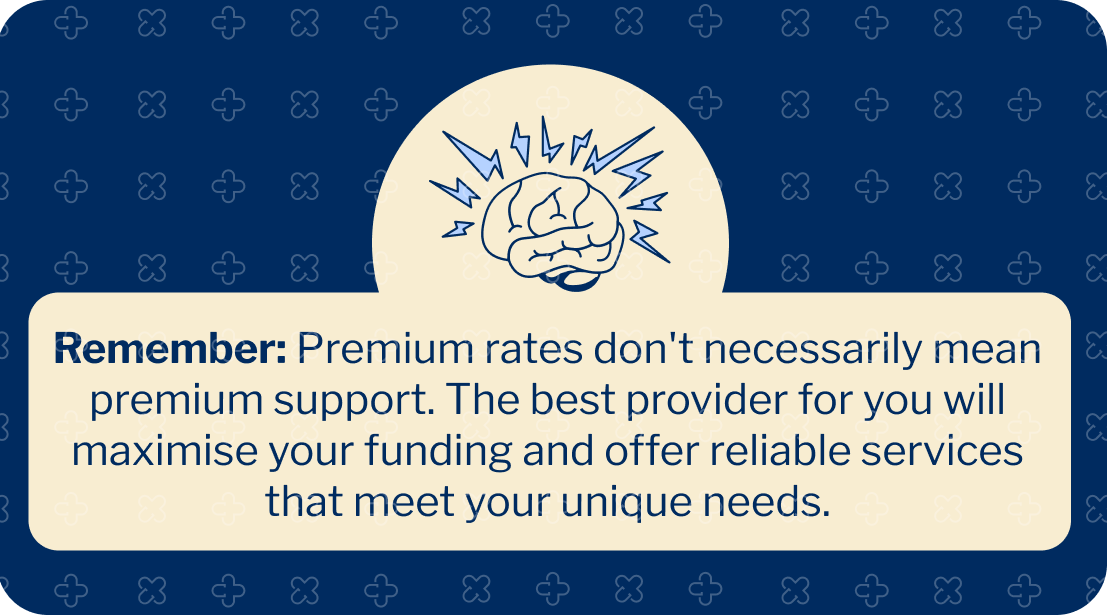
It’s important to note that a provider that charges a premium for its services does not necessarily offer a higher-quality service, and one that charges lower rates does not mean its services are of lower-quality. Your goal should be to find a provider that delivers good value: one that helps you maximise your funding while offering reliable services from qualified Care Managers and support workers that meet your evolving needs.
Pricing Resources and Choosing the Best Provider
The Australian Government offers resources to help you understand potential costs. The My Aged Care fee estimator, for instance, calculates an estimate of your potential contribution, and webpages like this Costs and Contributions page provide the most up-to-date information about budgetary matters.
Ultimately, choosing the best home care provider for your situation extends beyond just pricing. While costs are undoubtedly important, they should be weighed against the provider’s quality of care, reliability, and suitability for your personal needs. Once you’re approved for the Support at Home program, use the Find a Provider tools on My Aged Care to create a short list of your top options. Then, contact each of those options and ask questions, making sure you fully understand the breakdown of service costs.
If you’d like more in-depth instruction about finding the best provider for your care needs, visit our How to Find a Home Care Provider guide.
Additional Support at Home Resources
Support at Home pricing has a lot of moving parts, but hopefully this article clarifies the current situation and gives you the confidence to communicate with providers, advocate for yourself, and secure the support you deserve.
Here are some additional Support at Home resources and aged care guides you might find helpful: